
04.08.2026
Good Weather Is Not a Strategy: How a Real Plan B Makes a Venue Easier to Book
A strong event venue should work in more than perfect weather. This guide explains how venue owners can create a credible contingency plan with suitable spaces, clear decisions and reliable communication.
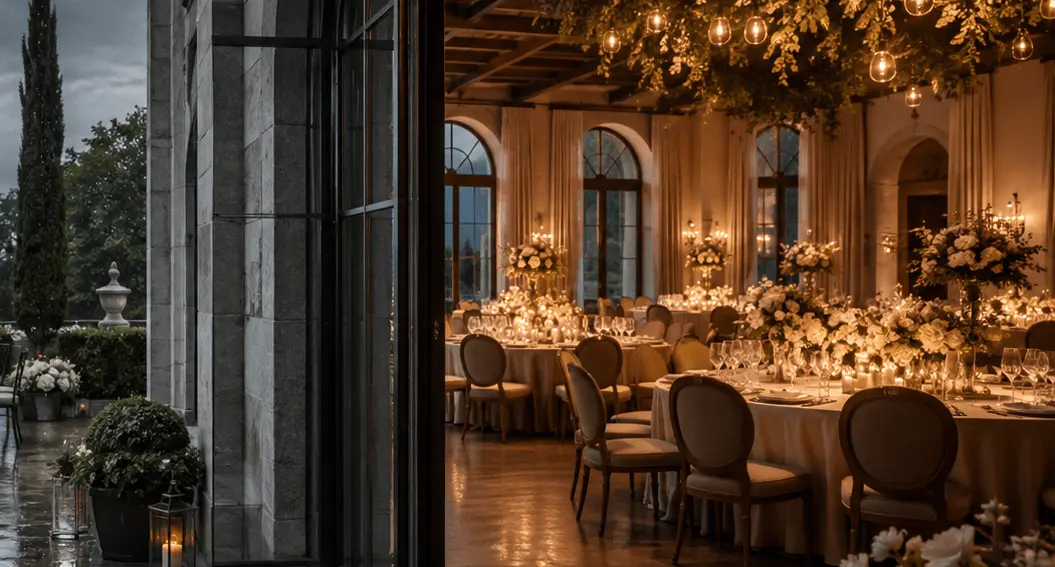
For planners, a credible Plan B is not a minor detail. It influences whether a venue feels dependable or whether uncertainty may appear shortly before the event. A premium venue should therefore show more than how impressive an occasion can look in perfect conditions. It should also explain how the atmosphere, service and programme will be protected in rain, wind, extreme heat or cold.
## Plan B should be part of the offer, not an emergency solution
Many venues simply state that an indoor space is available. That does not provide enough information for a serious booking decision.
A complete contingency plan should answer practical questions:
- Can the alternative space accommodate the same number of guests?
- Can the dinner, reception, presentation and dance floor still take place?
- Will catering, service and technical equipment remain available?
- Can guests reach the event area without being exposed to the weather?
- Who decides whether the event moves indoors, and when?
When these details are clear before an enquiry is sent, the venue appears better organised. The alternative should not feel like an improvised backup room. It should feel like a second, fully considered version of the event.
## The alternative space must match the event
A covered room is not automatically an equivalent solution. Its value depends on whether it can support the actual format of the occasion.
A seated dinner requires a different layout from a standing reception. A wedding may need room for a ceremony, dinner, music and dancing. A corporate event may require a stage, presentation equipment, branding areas and space for networking.
Venue owners should therefore provide more than a maximum capacity. It is more useful to describe realistic setups such as:
- Seated dinner with tables
- Standing reception or drinks
- Theatre-style presentation
- Wedding dinner with dance floor
- Product launch with a stage or display area
This allows planners to understand immediately whether the weather alternative genuinely suits their event.
## Decide in advance when the plan will change
One of the greatest sources of pressure is often not the weather itself, but a decision made too late.
Once furniture, decorations, catering stations and technical equipment have been installed, moving the event can become complicated. A clear decision point should therefore be agreed in advance. Depending on the event, the final call might be made the evening before, on the morning of the event or several hours before guests arrive.
Responsibility must also be defined. Does the venue owner decide, or is the decision made by the client or an event agency? Which forecast will be used? Will there be additional costs if both versions of the setup must be prepared?
Clear rules prevent last-minute discussions when every team should already be focused on delivering the event.
## Guest movement is part of the contingency plan
Plan B concerns more than the main event room. The entire guest journey must still work.
Guests need to know where they can arrive during heavy rain, whether the entrance is covered and where wet coats or umbrellas can be stored. Larger events may require additional signage, entrance staff or a revised shuttle procedure.
The cloakroom, toilets, smoking area, accessible entrance and parking route should remain easy to reach in either setup. An attractive indoor room loses part of its value when guests must cross an exposed courtyard to enter it.
## Include technical teams and suppliers early
Sound, lighting, electricity and presentation systems can be difficult to move at short notice. Equipment designed for a terrace may not work in exactly the same way inside another room.
Venue owners should confirm:
- Whether enough power connections are available
- Whether the sound system can be used in both spaces
- Whether indoor noise or time restrictions apply
- Whether a stage or projection surface can be installed
- Whether musicians, photographers and caterers can continue without a long interruption
- Whether secure areas exist for equipment and sensitive materials
External suppliers should also know early that two possible layouts may be required. This helps them plan staffing, equipment and installation time more accurately.
## Show both versions of the event
Many venues present almost exclusively their most impressive outdoor photographs. Potential clients are then left to imagine what the event might look like in poor weather.
A professional venue profile should show both options. Include photographs of the indoor space, different layouts, real evening events and a clear floor plan. Captions can explain the guest count and event format shown in each image.
The contingency space should not be hidden. A well-presented indoor solution creates confidence and demonstrates that the venue is prepared for complex events.
## Questions planners should ask before booking
Before confirming a venue, planners should clarify:
- Which space will be used in poor weather?
- How many guests can it accommodate comfortably?
- Can every part of the planned programme still take place?
- When will the decision to move be made?
- Who pays for additional work if two layouts must be prepared?
- Which parts of the event may need to change?
- Can catering, decoration and technical equipment work in both spaces?
- How will guests and suppliers be informed?
Well-managed venues do not wait for clients to discover these questions. They include the most important answers in their venue profile, offer and pre-visit communication.
## A strong Plan B protects the quality of the event
The weather cannot be controlled, but the preparation can.
A venue is not professional because it promises perfect conditions. It is professional because it offers realistic alternatives, defines responsibilities and guides clients clearly when circumstances change.
For venue owners, this can mean fewer rushed conversations, more suitable enquiries and an offer that is operationally convincing as well as visually attractive.
For planners, it means greater confidence when booking and the reassurance that the entire event does not depend on a single weather forecast.
On EventExclusive, venue owners can present their spaces with clear information, suitable images and realistic usage options. A remarkable venue should demonstrate its value not only in sunshine, but also when a well-designed Plan B becomes essential.